Furniture · Platform Bed Frames
Reclaimed Wood and Natural Finishes: A Closer Look at The Clean Bedroom Taconic
A bed frame is a quiet piece of architecture. It holds a mattress, occupies a large share of the bedroom, and—if it is well chosen—asks for little attention while shaping the character of the room. The Clean Bedroom Taconic makes a case for that sort of restraint: reclaimed wood, a simple platform form, and a finish intended to let the material remain visible.
Published October 20, 2026
There is a particular intimacy to furniture made from wood that has already had a life. Its surface may retain variations in tone, marks, and grain that do not arrive by design so much as by inheritance. Reclaimed wood carries that history into a new room, where it can be read as texture rather than anecdote. It does not need to announce where it came from; its irregularities are enough to suggest that it has not been manufactured to look perfectly uniform.
The Clean Bedroom Taconic is described as a platform bed handcrafted in the United States from 100 percent reclaimed wood. Its design is deliberately spare. There is no elaborate ornament competing with the material, and the low, straightforward structure is meant to support a mattress without making the frame the room’s principal event. For people considering natural bedroom furniture, the Taconic offers a useful opportunity to look closely at three practical questions: what reclaimed wood contributes, how a water-based finish affects the surface, and what closely spaced slats mean for a mattress.
Those questions matter more than a tidy phrase such as “eco-conscious” can convey. Materials have histories, finishes have properties, and frames have dimensions that must work with the mattress and the room. The appeal of a bed is partly visual, but it is also a matter of fit: whether its proportions suit the space, whether its support system meets the mattress maker’s requirements, and whether its upkeep is compatible with ordinary life.
Reclaimed wood, and the interest of a second life
Reclaimed wood is lumber recovered for reuse rather than newly harvested for a particular product. The term can cover materials from many prior settings and uses, so it is not a promise of one particular appearance. In a finished bed frame, reclaimed boards may show differing grain patterns, shifts in color, and small surface variations. A piece may look more lived-in than a frame made from freshly milled, carefully matched boards. That character can be a virtue, though it is not necessarily what every buyer wants.
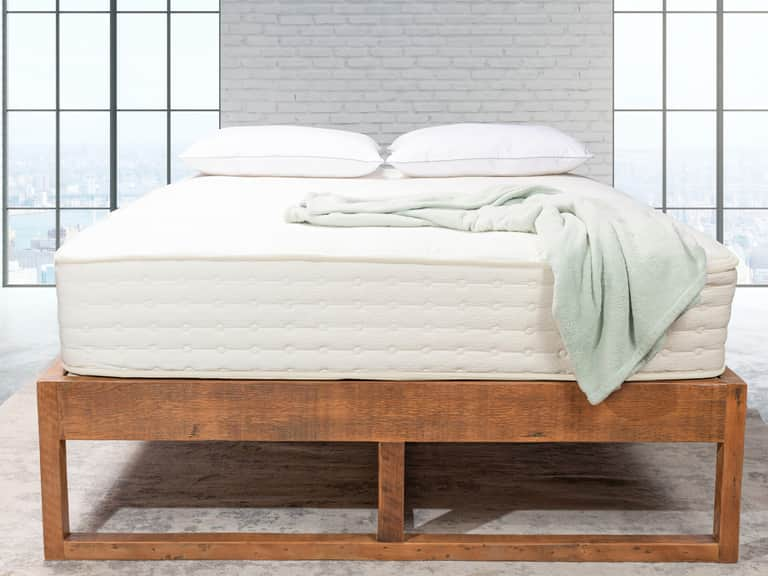
In the Taconic’s case, the product description identifies the frame as made from reclaimed wood and offers three finish choices: Rustic Raw, Smooth Natural, and Double Espresso. Rustic Raw is described as showing the wood’s rustic patina; Smooth Natural is intended to let its natural appearance show through; Double Espresso supplies a darker look. The wood is sealed with a clear, matte finish rather than having its natural tones substantially altered. A matte surface tends to keep reflections subdued, which can help a wood frame feel less glossy and formal. The actual impression, of course, depends on the wood itself and the light in the room.
That variation is part of the bargain. A reclaimed-wood frame is not the best choice for someone who wants every rail to match every other rail, or who expects a smooth, untouched surface throughout. Natural variation can be subtle or pronounced. If consistency is important, it is sensible to ask the seller what variation to expect, whether finish samples are available, and what the return or exchange terms are. A written description can establish the general character of an item, but it cannot make every board identical.
There is also a difference between the appeal of reused material and a complete environmental accounting. Reuse can extend the service life of existing wood, but the overall impact of a piece depends on several factors: how the material is recovered and processed, the adhesives or coatings used, manufacturing and transport, and how long the finished frame remains in service. The Taconic’s reclaimed construction is a meaningful material detail; it should not be mistaken for a quantified environmental assessment unless the maker provides one.
For the buyer, the most practical question may be simpler: does this material suit the room and the household? Wood with visible character often works comfortably alongside linen, cotton, wool, and other tactile materials. It can temper a modern room that feels too polished, or give a minimal bedroom some warmth without adding a patterned headboard or decorative trim. Conversely, a rustic finish may feel at odds with a room organized around highly uniform surfaces. The best choice is not the most virtuous-sounding one. It is the one that can live naturally with what is already there.
A finish is more than a color
The Taconic is described as having a non-toxic, water-based finish. That language is useful as a starting point, but product claims deserve careful reading. “Water-based” describes a category of coating, not a universal guarantee about every ingredient, emission, or performance characteristic. “Non-toxic” is broad language, too; buyers who have specific sensitivities or standards in mind should ask the seller for supporting details and clarify exactly what the claim covers.
Finish affects the way wood looks and how it behaves in daily use. A clear, matte coating can help protect a surface while keeping the grain visible and limiting shine. It may also make routine dusting easier than an entirely untreated surface. But a finish is not a force field. Spilled liquids, abrasive cleaners, prolonged dampness, and direct heat can damage wood or its coating. The sensible approach is to follow the care instructions supplied with the bed, use a soft cloth for ordinary dust, and avoid introducing cleaning products that have not been recommended for the finish.
The available finish names also invite a useful distinction between a material’s actual color and the way a finish presents it. Rustic Raw emphasizes patina; Smooth Natural signals a more even, understated presentation; Double Espresso introduces a darker tone. Since reclaimed wood naturally varies, a named finish should be understood as a broad visual direction rather than a guarantee that each component will share precisely the same shade. If the frame will sit beside existing furniture, floorboards, or cabinetry, it may help to compare samples in the bedroom’s own light. Morning light, lamplight, and the cooler light of an overcast Pennsylvania afternoon can make the same wood read differently.
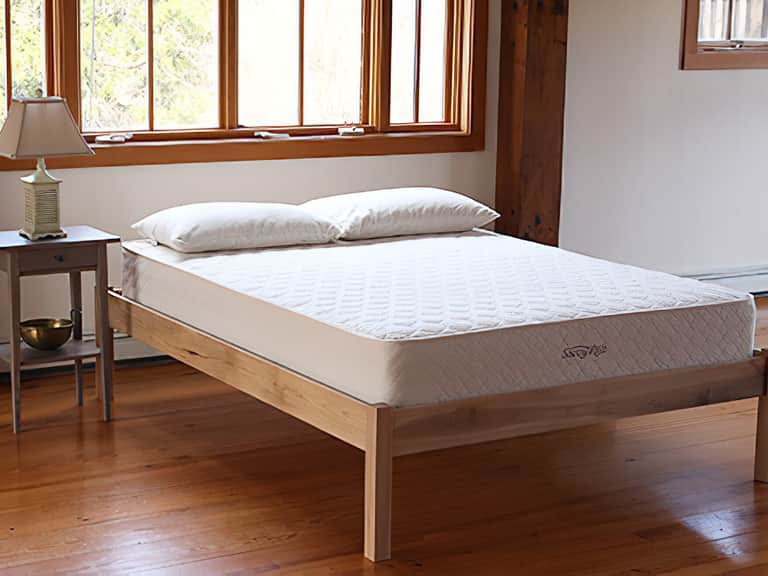
A natural-looking finish does not have to make a room feel rustic. The Taconic’s simple platform design gives it room to move between styles. Against pale walls and plain bedding, it can read as quiet and contemporary. Beside older furniture, woven textiles, or a patterned rug, the wood’s variation may feel more traditional. In a small room, a simple frame can keep visual noise down; in a larger one, bedding, lighting, and bedside tables can supply the layering the frame itself declines to provide.
The bed has no need to become a display of environmental virtue. Its more persuasive quality may be its refusal to disguise the material. A clear, matte finish lets the wood remain legible, and the restrained form makes that surface the central detail. This is not minimalism as austerity. It is closer to the feeling of a room in which every object has been allowed to settle into its place.
The quiet engineering of slats
Below the mattress, the less picturesque facts begin. The Taconic’s solid wood slats are positioned no more than 2.5 inches apart, according to its product description. That spacing is one of the most useful details to check when evaluating a platform bed. The mattress rests on the support system, and its manufacturer may specify a maximum distance between slats, a particular kind of base, or other requirements. A close spacing can provide a more continuous foundation than widely separated slats, but compatibility should be confirmed rather than assumed.
Mattress construction matters. Foam, latex, hybrid, and innerspring models may have different support requirements, and recommendations can vary even within a category. Before buying a frame, consult the mattress warranty and care guidance. Check the permitted slat spacing, whether a center support is required for larger sizes, and whether the mattress needs a solid or ventilated base. If the bed and mattress instructions differ, ask the manufacturers or retailer to clarify the issue before assembly. A frame that looks sturdy is not automatically a suitable base for every mattress.
Slats also leave room for air to move beneath the mattress. Ventilation can be a practical consideration, especially where a mattress sits close to a cool floor or in a room with limited circulation. It should not be treated as a promise that a mattress will remain free of moisture or that a particular sleep temperature will result. Room humidity, bedding, ventilation, the mattress materials, and household habits all contribute. The useful point is that an open platform is not the same construction as a solid, sealed surface.
The Taconic is presented as a simple platform frame that can support organic mattresses. That phrasing describes the intended use, not a reason to skip the specifications of the mattress being considered. Check dimensions carefully, including the mattress size and the frame’s external footprint. A nominal queen mattress, for example, is not the same thing as the full amount of floor space a bed will occupy once its rails and any headboard are taken into account. Leave room for drawers, doors, bedside tables, and the unglamorous but necessary act of walking around the bed.
Assembly and ongoing stability belong in the same conversation. Ask what tools are needed, how many people are recommended for assembly, and whether the frame should be checked periodically for loosened connections. Floors are rarely perfectly level, and even a well-made frame can make noise if a joint is not seated properly. These are ordinary household details, not defects in design. A good buying decision anticipates them rather than treating a bed as a sculpture that will never be touched.
How a minimalist bed occupies a room
A platform frame has a certain composure. Because its structure does not rely on a separate box spring in the conventional arrangement, it can offer a relatively direct relationship between floor, frame, and mattress. The Taconic’s simple lines make it adaptable, but “fits into any decor” is best understood as a statement about restraint, not literal universality. The dimensions of the room, the height of the mattress, and the furniture already in place will all influence whether it feels at home.
Before selecting a finish, consider the room as a whole. A warm wood tone may pick up the color of a floor or bedside table; a darker finish can anchor a pale room but may feel heavy in a compact one. The effect changes with bedding. White or undyed textiles can make the grain more noticeable, while colored or patterned bedding shifts attention elsewhere. A low-profile frame can also make a tall mattress appear more dominant, so the combined height—not the frame alone—is the number to consider when judging proportions.
Storage is another practical question. The available description emphasizes platform support and a streamlined design, but does not provide all measurements a shopper may need for clearance or under-bed storage. If baskets, cleaning equipment, or a robotic vacuum need to pass beneath the frame, verify the actual height and leg arrangement before purchase. Likewise, anyone planning to add a headboard should check how it attaches and whether the bed’s design accommodates the desired piece. The Taconic’s minimalist appearance is part of its appeal; it may not provide every feature associated with a more elaborate bed.
In Pennsylvania homes, where bedrooms may be in older row houses, farmhouses, apartments, or newer developments, room dimensions and floor conditions can vary considerably. A frame’s style may travel well across those settings, but its physical fit remains local and specific. Measure the room, the path from the entrance to the bedroom, and any stair turns or narrow hallways involved in delivery. A bed that fits beautifully between the walls still has to make it through the door.
A thoughtful checklist before buying
The Taconic’s materials and appearance are compelling points of entry, but a sound purchase depends on details that are easy to overlook in a product description. A short checklist can turn a general impression into a more confident decision.
- Confirm mattress compatibility. Compare the stated slat spacing with the mattress maker’s requirements, and check any warranty language about foundations or support.
- Measure the full footprint. Account for the frame’s exterior dimensions, mattress height, room circulation, bedside furniture, and the route used for delivery.
- Ask about reclaimed-wood variation. Clarify what the selected finish looks like, how much board-to-board variation is expected, and whether samples are available.
- Clarify finish information. If “non-toxic” or low-emission characteristics are important to you, request precise documentation rather than relying on a broad label alone.
- Review care and assembly instructions. Learn which cleaners to avoid, whether periodic tightening is recommended, and what tools or assistance assembly requires.
- Consider the room’s practical needs. Check under-bed clearance, headboard compatibility, and whether the frame provides the storage access or height you want.
None of these questions diminishes the pleasure of choosing furniture. They are, instead, the domestic equivalent of looking at a map before setting out. A frame is meant to be used every day; its small specifications become large through repetition. The distance between slats, the height of the mattress, and the ease of cleaning beneath the bed can matter more over time than a detail that looked decisive on a screen.
The Taconic in perspective
The The Clean Bedroom Taconic Bed is best understood as a considered platform frame rather than a complicated sleep system. Its defining features are clear: reclaimed wood, a water-based finish, a minimalist silhouette, and solid wood slats no more than 2.5 inches apart. The choice of Rustic Raw, Smooth Natural, or Double Espresso gives buyers different ways to meet the same basic form, while the clear matte approach keeps the wood’s character in view.
Those features may suit someone who values a restrained bedroom, prefers the visible variation of reclaimed material, and wants a frame that does not overwhelm the mattress or the rest of the furnishings. They may be less suitable for someone seeking an exactly uniform wood appearance, built-in storage, or a highly decorative headboard. The distinction is not between good taste and bad taste; it is between different domestic priorities.
The frame’s promise, if one wants to call it that, is modest. It does not claim to transform sleep by itself, and no bed frame can substitute for a mattress chosen to suit the sleeper. Instead, the Taconic makes its contribution in the background: a stable platform, a visible material history, and a finish that leaves the wood recognizable. A bedroom often benefits from such modesty. It is a room designed for rest, and not every object in it needs to perform.
Reclaimed wood brings the past into a bedroom without requiring a story about where each board has been. Natural finishes keep attention on surface and grain; close slats invite the practical check of mattress compatibility. Together, these qualities make the Taconic a useful example of how furniture decisions can combine aesthetics with ordinary engineering. The most satisfying choice will be the one that looks at ease in the room and works just as quietly beneath the mattress.